Call Dr. Sharma's Clinic - From United States and Canada call 703-659-0873. Patients From rest of the world and India call +91-6283487321

10 Best Homeopathic Remedies for Treating Common colds

Homeopathic Remedies for ColdThe common cold is a viral infection that affects the nose and throat. It can be caused by different viruses, mostly rhinoviruses. On average, adults may suffer from three to four colds a year, but children may have even more such bouts.

Homeopathic medicines offer wonderful treatment for such cases. Natural homeopathic remedies for colds reach the root of the problem and ensure that the viral infection is rooted out of the body. They fight the infection-causing agent and offer excellent relief in the symptoms of common cold, including runny nose, stuffy nose, sneezing, sore throat, coughand post-nasal drip (PND). Once you get a cold, the instant human reaction is to somehow get rid of it as soon as possible. Allopathic medicines or over-the-counter medication may provide you with some instant relief from a runny or stuffy nose, sneezing, headache and body ache for a short duration, but the infection does not leave your body. The cold, or the viral infection of the upper respiratory tract, recurs and that can be even more troublesome. Here is where homeopathic remedies can be of great help. They can cure it effectively by eradicating the virus from the body.

Homeopathy Boosts Body’s Self-healing Mechanism

Every person has a self-healing process in the body. Homeopathic medicines boost the body’s internal healing mechanism. They help fight the infection that causes a cold and help in eliminating it from the body to aid in natural healing. These medicines also cut short the recovery time and prevent complications.

Natural and Safe Medicines

Homeopathic medicines to treat cold are made from natural substances. They do not carry any type of chemicals or toxins, and hence, are completely safe. They ensure natural recovery and do not cause any kind of side effects. These medicines suit people of all age groups.

Individualized Approach Towards Treatment

Homeopathic medicines for cold are administered according to the characteristic symptoms in every individual case. The potency and dosage vary according to the age of the person, the type of medicine, duration and the severity of a cold. Therefore, it is advised to take homeopathic medicines for a cold as recommended by a qualified homeopath for the best possible results. Self-medication should be avoided.

Homeopathy Builds Immunity Against Recurrent Cold

There are different sets of medicines in homeopathy to treat acute cold and to treat the tendency to get recurrent colds. The treatment for an acute cold needs to be taken for a few days to a week. On the other hand, the treatment period for chronic cold includes a few months, depending on the individual case. Homeopathic medicines are constitutional remedies administered individually for every case as per the detailed symptom analysis. These medicines gradually build immunity to prevent recurrent cold, thus reducing the number of episodes of cold per year. With its use, dependence on conventional medicines like antibiotics, decongestant nasal drops/sprays, etc. is reduced to a huge extent.

Top 10 Homeopathic Remedies For Common Colds

The top homeopathic medicines to treat common cold are Arsenicum Album, Aconitum Napellus, Natrum Muriaticum, Hepar Sulphuris, Belladonna, Pulsatilla Nigricans, Sabadilla Officinalis, Eupatorium Perfoliatum, Allium Cepa and Gelsemium Sempervirens.

 1. Arsenicum Album – For Cold With Thin Watery Nasal Discharge

Arsenicum Album is beneficial for curing the common cold, especially when there is a thin watery discharge from the nose. The nose may feel stuffy in spite of the discharge that causes a burning sensation in the nose. Most of the time, it is accompanied by sneezing. Those who need this medicine feel worse in cold air. Being in a warm room can provide some relief. Weaknesses can be marked along with the above-mentioned complaints.

When to use Arsenicum Album?

It is a highly recommended medicine for the initial stages of a common cold when there is thin, watery nasal discharge. A stuffed nose may attend it.

How to use Arsenic Album?

Though it can be used in various potencies, the most frequently used potency is 30C twice a day.

2. Aconitum Napellus – For Cold After Exposure To Cold Air

Aconitum Napellus is a natural medicine sourced from the plant ‘Monkshood’. It is undoubtedly the best and most effective remedy when someone catches a cold after sudden exposure to cold air, like from the air conditioner or in cold weather. The symptoms to use Aconite are scanty nasal discharge with a stuffy nose. Sneezing may also be experienced. The other accompanying symptoms are pain at the root of the nose, headache and fever.

When to use Aconitum Napellus?

This medicine should be the first choice of medicine for anyone who catches a cold from sudden exposure to cold air.

How to use Aconitum Napellus?

The suggested dose of this medicine is usually Aconite 30C twice or thrice a day, as per the severity of the symptoms.

3. Natrum Muriaticum – For Cold that Starts with Sneezing

Common colds that begin with sneezing are treated wonderfully with this medicine. Along with sneezing, there is a thin watery nasal discharge. It may be followed by a stuffy nose, which may also cause a loss of smell.

When to use Natrum Muriaticum?

It should be used as the first line of treatment when a cold starts with sneezing as the first symptom, followed by thin watery nasal discharge.

How to use Natrum Muriaticum?

The most widely used potency of this medicine is 6X, which can be taken three to four times a day, at a gap of at least three hours.

4. Hepar Sulphuris – For Common Cold with Stuffy Nose

This medicine is the most effective to help in cases of a stuffy nose. In cases where the nose feels stuffy and blocked, this medicine is known to help with secretions and generally ease the complaint. To be more specific, it is indicated for a stuffy nose from exposure to cold air, which causes sneezing.  A very particular symptom that may accompany is inhaled air that feels cold. It is also the best medicine for treating a cold in the winter.

When to use Hepar Sulphuris?

If you have a stuffy nose due to a cold, this medicine offers the best results. It will help with nasal discharge and bring relief. For treating winter colds, too, this is the best medicine.

How to use Hepar Sulphuris?

It is advised to take this medicine in 30C potency once or twice a day to get the best possible results.

5. Belladonna – For Cold Associated with Sore Throat

It is the most frequently prescribed medicine when pain in the throat accompanies nasal symptoms. It is used when there is watery discharge from the nostrils, especially one-sided. This is accompanied by sneezing and tickling in the nose. Along with this, there is a sore throat, painful swallowing, marked redness and swelling in the throat. There may also be bouts of cough and headache.

When to use Belladonna?

This medicine is best for a cold that presents with nasal symptoms (like nasal secretions, sneezing) and sore throat with marked throat pain. Additionally, it is also a top choice for managing headaches in colds.

How to use Belladonna?

The recommended dose to use this medicine is in 30C potency, two to three times a day for relief.

6. Pulsatilla Nigricans– For Thick Yellow Green Nasal Discharge

This natural medicine derived from the plant ‘wind flower’ possesses wonderful healing properties that help treat the common cold. This medicine is best suited in the late stage of the common cold when the nasal discharge starts to change color to yellowish-green and consistency changes from thin to thick. Along with this, there may be nasal blockage and loss of smell.

When to use Pulsatilla Nigricans?

Pulsatilla can be used whenever a characteristic thick yellowish or greenish nasal discharge is present.

How to use Pulsatilla Nigricans?

Pulsatilla 30C can be administered one or two times daily for the best possible results.

7. Sabadilla Officinalis– For Violent Sneezing and Nasal Irritation

Sabadilla is administered when the common cold begins with repeated bouts of sneezing, burning sensation and watery discharge from the nose, redness of the eyes, and itching of the soft palate. The patient feels better in warm rooms and feels uneasiness in cold air. There is a peculiar sensation as if the throat is raw or scalded. Symptoms often resemble allergic rhinitis or hay fever-type colds.

 When to use Sabadilla Officinalis?

It should be used if there is violent, spasmodic sneezing with watery discharge from the nose and eyes, with intense itching and tickling in the nose and throat.

How to use Sabadilla Officinalis?

It is usually prescribed in 30C potency, 3–4 times daily in acute colds until there is relief. Once the symptoms start to improve, stop taking medicines.

8. Eupatorium Perfoliatum – For Cold with Severe Body Pains

 Eupatorium is mainly indicated when the common cold is accompanied by fever, chills, and marked body pains. There is coryza with hoarseness, sneezing, and soreness of the chest. The patient feels extremely restless due to aching of limbs and back. Thirst for cold water is usually marked. It is useful when a cold is progressing towards a flu-like illness.

When to use Eupatorium Perfoliatum?

It is used when there is a cold along with intense aching in bones and muscles as if they are broken.

How to use Eupatorium Perfoliatum?

It can be taken in 200C potency once or twice daily if there is severe body ache with symptoms of a cold. Lower potencies like 30C can be used 3 times daily for the best possible results.

9. Allium Cepa – For Runny Nose with Watery Eyes

Allium Cepa is one of the most common remedies for the initial stage of a cold. There is profuse watery discharge from the nose that results in a burning sensation in the upper lip and nostrils, with constant sneezing. Eyes water, but the tears are mild and do not irritate. Symptoms aggravate in warm rooms and they get better in the open air. Headache with coryza and tickling cough may also be present.

When to use Allium Cepa?

It is best administered when there is an acrid, burning sensation in the nasal discharge with bland (non-irritating) tears.

 How to use Allium Cepa?

It can be taken in 30C potency, thrice daily during the acute stage. In the early stages of a cold, frequent repetition offers the best possible results.

10. Gelsemium Sempervirens– For Cold with Drowsiness and Weakness

Gelsemium is suited when the patient feels tired, sluggish, and wants to lie down. There is watery discharge from the nose accompanied by sneezing, headache, and heaviness of the eyelids. Chills run up and down the spine, with little or no thirst. Cold progresses gradually with trembling and prostration. The face may feel flushed and hot.

When to use Gelsemium Sempervirens?

It is administered during the early stages of a viral cold along with a lot of weakness, heaviness, and drowsiness.

How to Use Gelsemium Sempervirens?

It is generally prescribed in 30C or 200C potency, and should be taken 2–3 times daily depending on its severity. It is very useful in the early stages of the viral cold.

Note: One may use this medicine for about a week’s time in the recommended dosage. Do not indulge in self-medication. In case symptoms do not subside within a week, consult a qualified homeopath for the next course of action. In case of any complications, like any lung-related problem (eg., asthma, pneumonia), it is best advised to urgently go for a conventional mode of treatment.

What Is The Cause Behind Common Colds?

The common cold can be caused by approximately 200 different strains of respiratory viruses. Among these viruses, rhinoviruses are the most common, followed by adenovirus, respiratory syncytial virus, etc. Once the virus enters the nose or throat, it sticks to the mucus lining and starts multiplying. Our body responds to this infection, which results in inflammation in the nose or throat and thus excess production of mucus.

Are Common Cold and Flu Same?

Though the symptoms of both these conditions are quite similar, these are two different conditions. Both are caused by different viruses (the common cold usually arises from rhinovirus infection and flu is caused by influenza virus). The symptoms of flu are more severe than those of the common cold. Fever, chills and headache with nasal symptoms mostly point towards flu rather than common cold.

How Does Common Cold Spread?

The common cold is very contagious and spreads via direct contact from people who are ill to others. The common cold virus can enter the body through the nose, mouth or eyes.

Firstly, one tends to catch a cold by inhaling virus-infected droplets in the air from coughs or sneezes of a sick person who suffers from the common cold.

Secondly, it can spread through hand-to-hand contact with a person suffering from the common cold.

Thirdly, one can acquire infection by touching a surface or due to sharing of utensils, towels, etc that have been contaminated by viral droplets emanating from a sick person, and then touching the eyes, nose, or mouth without properly washing hands.

What Are The Symptoms Of Common Colds?

The symptoms of the common cold start to show up within 1-3 days after exposure to the virus that causes the common cold.

The symptoms include:

1. Stuffy or runny nose,

2. Sneezing, sore throat, cough.

3. General symptoms like headache, low-grade fever, general fatigue, and body aches tend to accompany.

4. Loss of smell or taste, post-nasal drip (PND) can also be present.

5. The nasal discharge is initially thin and clear, which turns thick and yellow/green as the condition progresses.

6. The symptoms of the common cold can last from one week to 10 days. The signs and symptoms vary from person to person.

Who Is At Risk Of Common Colds?

Though anyone can be affected by the common cold, some factors increase the risk.

1. Age: Although cold can affect people of any age group, children are the most at risk. This is because the immune system of children is gradually building up and is still learning how to fight infections. The risk of catching an infection increases if a child goes to a daycare facility.

2. Time of year: Though the common cold can hit a person at any time of the year, the chances are higher in autumn, winter and rainy season.

3. Weak immune system: People with weak immunity due to some long-standing health issues are more prone to catch common cold frequently.

4. Environment: Being in crowded places like schools, shopping centres, malls, tourist places, etc seems to increase the risk of getting exposed to viruses and catching a cold.

Are There Any Complications of Common Colds?

In most cases, recovery from a common cold occurs in a week to 10 days without any complications. People with weak immunity might face some complications, such as ear infections or sinus infections. In some cases, the infection travels downwards and can lead to acute bronchitis (also called chest cold which refers to inflamed bronchial tubes that carry air to and from lungs), asthma (inflammatory airway disease that leads to difficult breathing, wheezing, chest tightness and cough) and pneumonia (inflammation of air sacs of lungs) that need to be treated by a doctor. Self-medication should be strictly avoided.

Frequently Asked Questions

1. Are homeopathic medicines helpful in common cold?

Yes, homeopathy can help reduce the intensity and duration of symptoms when medicines are selected according to individual symptoms.

2. How long does a common cold usually last?

Mostly a cold improves within 5 to 7 days. In some cases, mild symptoms like cough or nasal congestion can continue for up to 10–14 days.

3. Is fever common in a cold?

Mild fever can occur, especially among children. In adults, high fever is less common and may indicate another infection like flu.

4. When should I see a doctor for a cold?

You should consult a doctor if symptoms last more than 10 days, if the fever is high, if there is a severe headache, chest pain, difficulty in breathing, ear pain, or if the mucus becomes thick, yellowish-green, accompanied by severe sinus pain.

5. Can antibiotics cure the common cold?

No. Antibiotics do not help in common cold because it is caused by viruses. They are only needed if a bacterial infection develops as a complication.

6. What can I do at home to feel better?

Take rest, drink plenty of warm fluids, take steam inhalation, gargle with warm salt water, and eat light, nutritious food. These simple measures help relieve symptoms and speed up recovery.

7. Can I continue my daily activities if I have a cold?

If symptoms are mild, you can continue routine work. However, proper rest is important, and it is better to avoid heavy physical exertion.

8. Is the common cold contagious?

Yes, it spreads easily from person to person through coughing, sneezing, and close contact. It is most contagious in the first 2–3 days.

9. How can I prevent spreading the cold to family members?

Cover your mouth while coughing or sneezing, wash your hands frequently, avoid sharing towels or utensils, and maintain some distance from others until you feel better.

10. Can a cold turn into something serious?

Usually, it is harmless, but sometimes it can lead to sinusitis, ear infection, bronchitis, or worsening of asthma in sensitive individuals.

11. What foods should I take during a cold?

Warm soups, herbal teas, fruits rich in Vitamin C, and easily digestible meals are helpful. Avoid drinks that are cold, and also avoid oily and junk food.

12. Does cold weather aggravate cold?

Cold weather itself doesn’t cause cold, but exposure to cold air may increase discomfort and congestion in some people.


Call Dr. Sharma's Clinic - From United States and Canada call 703-659-0873. Patients From rest of the world and India call +91-6283487321

How To Deal With Hypersensitivity To Cold With Homeopathy

Hypersensitivity to cold is also known as cold intolerance. Everyone feels cold in winter due to a decrease in the temperature in the environment. Those who face cold intolerance feel cold all the time no matter what the season. Cold intolerance may be attended with shivering, besides other features like numbness; pale, red or bluish skin discoloration; pain; stiffness and swelling. Persons with low body fat are usually predisposed to it. Deficiency of vitamin B12 may also be a reason. Other medical reasons could be responsible for this. First among these is anemia. Anemia refers to a condition in which there are not enough healthy red blood cells (RBCs) to take oxygen to different body tissues. Other signs and symptoms of anemia include pale skin, tiredness, headache, dizziness and shortness of breath. Another cause can be hypothyroidism. Hypothyroidism means an underactive thyroid which is a condition where thyroid gland is unable to produce enough thyroid hormones usually required in the body to function properly. This results in many signs and symptoms. Among these, hypersensitivity to cold/cold intolerance is an important one. Other signs and symptoms include weight gain, tiredness, puffiness of the hands, feet and the face, constipation, sleepiness, hair thinning, muscle weakness, joint pains, depressed feeling, decreased desire for sex, heavy menses in females, voice hoarseness and numbness in the hands.

Another reason can be Raynaud’s disease. It refers to a condition whereby the fingers and toes tend to become cold and numb from exposure to cold temperature or stress. This may occur due to spasm and narrowing of blood vessels that reduces the blood flow to the hand and toes. Firstly, the fingers and toes become pale white and afterward, blue and red. Hypothalamus disorders can be another reason for hypersensitivity to cold. Hypothalamus is a part of the brain that functions to regulate body temperature so any disturbance in its functioning could lead to cold hypersensitivity. Anorexia is yet another cause. It is an eating disorder in which the sufferer undergoes food restriction and eats small quantities of food due to fear of gaining weight. As a result, he/she suffers weight loss which reduces body fat that makes them prone to cold intolerance.  Another cause may be fibromyalgia. It is a condition that causes pain in different body parts at specific tender points accompanied by tiredness, memory issues, sleep problems and a depressed feeling. Cold intolerance may also be seen in cases of lupus/SLE (systemic lupus erythematosus). Lupus refers to an autoimmune disease in which healthy tissues and organs in the body become inflamed. They are damaged by the body’s immune cells that otherwise help in fighting infectious agents that cause diseases. It may lead to sensitivity to cold along with other main signs and symptoms. These include a butterfly-shaped rash on the face over the cheeks and bridge of the nose, joint pains, tiredness, fever, headache, and memory loss. Cold intolerance can also occur in cases of diabetes.

Homeopathic Management

Homeopathy can be of great help to people who have hypersensitivity to cold. Homeopathic medicines to manage such cases are natural remedies that help in these cases by working to treat the root cause behind it. Along with managing cold intolerance, they also help to relieve any attending signs and symptoms as well. The most suitable homeopathic medicine for these cases is selected after taking into consideration the characteristic symptoms in every individual case. So it is advised to get your case evaluated by a homeopathic physician for the right prescription. In no case, self -medication should be done.

Homeopathic Medicines For Hypersensitivity To Cold

1. Calcarea Carb – Leading Homeopathic Medicine

Calcarea carb is a top recommended medicine for managing cases of hypersensitivity to cold. Those needing this medicine have cold intolerance and a tendency of increased sweating. The cold and sweat are marked on the feet. Sweating on the head is also very prominent. The sweat may smell sour. The chilly feeling gets worse when one comes in contact with water. Body aches may occur from exposure to cold wind where this medicine is required. Numbness may be felt in the body parts on the side that a person lies down on. There is a tendency of becoming fat, obese and overweight. Calcarea carb is a major homeopathic medicine for hypothyroidism cases to manage its various related symptoms.

2. Hepar Sulph – For Cold Intolerance With Sensitivity To Draught Of Air

Hepar Sulph is a very prominent medicine for persons who always feel chilly. They are very sensitive to even the slightest draught of air. They tend to cough frequently as soon as exposure to cold air happens. Even if hands and feet get uncovered, it leads to a cough episode. There is a tendency to be wrapped up to the face even in hot weather. They are prone to recurrent cold and sinus infections from cold air exposure. In such cases, they get thick yellow nasal discharge. The nose swells and there is pain at the root of the nose along with soreness. This medicine is also indicated when cold intolerance gets worse when suffering from some health illness.

3. Silicea – For Cold Intolerance With Cold Hands And Feet

This medicine is well indicated for people who always feel cold. They have cold hands and feet all the time. This condition gets worse in winter. They feel chilly even while exercising. Generally, they sweat heavily. They have offensive sweat on their hands, armpits and feet. They also feel exhausted very easily from doing small chores. They also have unhealthy skin prone to easy pus formation from the slightest injuries.

4. Psorinum – For Extreme Chilliness

This medicine is highly recommended to those who feel extremely chilly and are intolerant to cold. They want to cover themselves up with warm clothes even in summer and the hottest weather, especially the head. They are fearful of cold air. They may suffer marked tiredness. They are usually thin and weak.

5. Sepia – For Chilly Feeling Even In Warm Room

Sepia is indicated for chilliness when a person feels chilly even in a warm room. The hands and feet feel icy cold. There is excessive sensitivity to cold air. There is excessive weakness even from walking a few steps. This medicine is indicated when there is hypersensitivity to cold in case of a long-term health illness.

6. Baryta Carb – For Cold Hypersensitivity With Cold, Sweaty Feet

Baryta Carb is another useful medicine for cases of cold intolerance with cold, sweaty feet. The sweat on the feet is foul. Those needing this medicine tend to get affected by cold very easily. Even on the slightest exposure to cold air, sore throat and tonsillitis occur.

7. Rhus Tox – For Cold Intolerance With Joint Pains

Rhus Tox is a well-indicated medicine for hypersensitivity to cold. Those who require this medicine cannot tolerate cold air. This medicine is especially of great help to manage cases where joint pains worsen in cold damp weather. Joints also feel stiff apart from being painful.

8. Aranea Diadema – For Hypersensitivity To Cold And Dampness

This medicine is indicated for those who are hypersensitive to cold and dampness. They feel the cold penetrating their bones. Bones feel as if made of ice. The chilly feeling does not decrease and one is not able to feel warm enough again. The head and feet are markedly cold.


Call Dr. Sharma's Clinic - From United States and Canada call 703-659-0873. Patients From rest of the world and India call +91-6283487321

Top 5 Homeopathic Medicines For Relieving Headache Due To Cold

Headache is a very common symptom when a person is suffering from cold. About 50 – 60 pc persons suffering from cold tend to get headache as one of the attending symptoms. The reason behind it is stuffiness in the nose from swollen mucus membrane that lines nasal passages and sinuses (air-filled cavities inside the skull bone). When a person has a cold, the membranes produce mucus in excess to get rid of the infectious agent. This mucus builds pressure in the sinuses causing congestion that could lead to headache.

Another reason behind it could be cytokines released by body’s defence mechanism that signal to fight against the virus causing cold. Some cytokines that lead to inflammation are linked with headache. The pain can be felt mostly in the forehead, around the eyes and at the root of the nose. One feels like tying a tight band of cloth around the head to apply pressure on the forehead to bring relief. The headache gets worse from sudden head movement and gets worse in the morning as there is a build-up of mucus during sleep that contribute to additional sinus pressure. Other symptoms of common cold include nasal stuffiness, runny nose, sneezing, sore throat, post nasal drip (PND), cough, fever, weakness and body aches.

Homeopathic Management

Homeopathic medicines are very effective in managing headache due to cold. These are natural remedies with zero side effects. These bring great improvement in acute cases of headache as well as long term cases of headache due to recurrent cold or sinus congestion. These medicines help fight infection and promote fluid drainage (which is causing headache from pressure build-up) from the nose and paranasal sinuses to aid speedy recovery. Along with headache, homeopathic medicines also work in relieving symptoms of cold including nasal discharge, nasal blockage, sneezing and weakness. Homeopathic medicines for managing headache are selected based on the characteristic individual symptoms in each and every case. As headache can occur from various reasons, it is advised to have your case evaluated by a physician to find the exact reason behind it based on which medicine should be taken.

Homeopathic Medicines For Relieving Headache Due To Cold

1. Belladonna – Top Remedy

Belladonna is a top recommended medicine for managing headache due to cold and sinus inflammation. In cases needing it, pain is felt especially in the forehead and sides of the head (temporal region). Usually, throbbing or pulsating pain is felt. Fullness and heaviness is also felt in the head. The face looks red along with heat. Headache gets worse from exposure to draught of air and lying down. It also gets worse from head movement and eye movement. It gets better by applying pressure over the forehead or binding the head tightly. Along with headache there is watery discharge from one side of the nose. Tickling in the nose, along with sneezing, is also present.

2. Natrum Mur – With Thin, Watery Nasal Discharge And Sneezing

Natrum Mur is a very beneficial medicine to manage headache with thin, watery nasal discharge and violent sneezing. A pressive pain is felt in the forehead and eyeballs. There is a sensation as if many small hammers are knocking on the head. It feels as if the head would burst. Headache along with pressure on the eyes is relieved by taking proper sleep. A weight is felt in the forehead. It gets worse on bending the head down and gets better by applying pressure. Nasal discharge may alternate with nasal blockage.

3. Kali Bichrome – For Pain With Nasal Stuffiness

This medicine is suitable for cases of headache with nasal stuffiness. There is pain in the forehead and at the root of the nose due to cold and sinus congestion. Throbbing is felt above the eyes with a sensation as if the head would burst. A pressure or a violent shooting pain is felt at the root of nose. There is thick yellow greenish sticky ropy or lumpy discharge from nose. Nose feels stuffed with discharge. In many cases, post-nasal discharge of ropy mucus is present. Headache gets better by pressing at the root of the nose and also from drinking warm fluids.

4. Aconite – For Headache From Cold With Fever

This medicine is suggested for managing headache from cold with attending fever. There is pulsating pain or bursting sensation in the forehead in cases needing it. Pain at the root of nose can be felt as well. There may be fluent discharge from the nose or dryness in the nose. There is frequent sneezing and redness, swelling of the nostrils.

5. Allium Cepa – For Pain In Forehead With Cold

Allium Cepa is an effective medicine when there is pain in the forehead along with cold. The pain gets worse in a warm room and better in the open. The pain may be dull or stitching type as from pricking of needles. The pain may extend to eyes and face in some cases. There is profuse watery nasal discharge that causes burning in the nostrils and on the upper lips. Intense sneezing is also felt. A lump is felt at the root of the nose. A watery discharge from eyes is also noted. Cough and hoarseness of voice may be present as well.

6. Gelsemium – For Dull Headache With Heaviness Of Eyelids

This medicine is very useful when there is dull headache with heavy eyelids. The pain may be present in the forehead or on the back of head. There is watery nasal discharge along with sneezing and fullness is felt at the root of nose. Tingling is felt in the nose and it also feels stuffed. Excessive weakness may be present. Fever can attend as well. In cases needing it, there may be a tendency to catch cold with every weather change.

7. Silicea – With Foul Smelling Nasal Discharge

Silicea is well indicated when there is headache with foul smelling nasal discharge. Nose feels stuffed. There is alteration between nasal discharge and nasal dryness. Loss of smell is there. Pain can be felt in the forehead, the top or back of the head. Headache gets worse from cold air and head movement. There is relief in headache from wrapping the head with a warm cover. Relief also occurs from binding the head or applying pressure.

8. Pulsatilla – With Thick, Yellow, Green Nasal Discharge

This medicine is recommended for managing headache with thick, yellow, green nasal discharge. There is alternate blockage of nose and nasal discharge. Mostly there is runny nose in the open air and stuffiness indoors. There is loss of smell and taste. Pain is felt on one side of the head and face. Watering in eyes can occur along with headache. Head feels heavy. There is relief from headache by going outdoors.

9. Nux Vomica – With Nasal Discharge In Day And Nasal Blockage At Night

Nux Vomica can be used in cases where headache occurs during the day and there is nasal blockage at night. There is watery nasal discharge in day time and nasal dryness at night. There is excessive sneezing and a crawling sensation is felt in the nose. Other symptoms are watering from eyes and headache in the forehead with urge to press the head against something hard.


Call Dr. Sharma's Clinic - From United States and Canada call 703-659-0873. Patients From rest of the world and India call +91-6283487321

Sinusitis – Homeopathy for Sinusitis

Sinusitis in Cold Weather – Homeopathy

Although sinusitis can occur in any weather but for those who suffer from sensitivity to cold weather, sinusitis can be a major issue in these months. ‘Sinusitis’ is a term referred to the inflammation of the sinuses (4 pair of air spaces in the skull). People who are sensitive to cold weather have a tendency to develop recurrent colds cough and sinusitis. Cold weather itself does not cause sinusitis but predisposes individuals who are sensitive to cold weather to develop recurrent colds and upper respiratory infections, which in turn causes issues like sinusitis. Homeopathy has an excellent treatment for sinusitis and also for helps in treating ones ‘cold weather sensitivity’ very effectively – Thereby by improving ones resistance to cold weather related problems. [Read more…]

Call Dr. Sharma's Clinic - From United States and Canada call 703-659-0873. Patients From rest of the world and India call +91-6283487321

First aid when cold starts

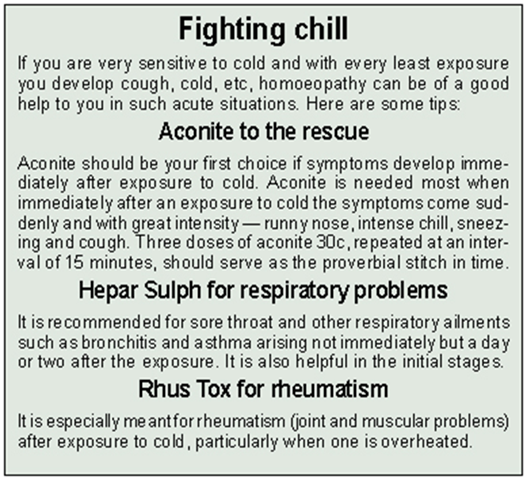
With the change in the weather, the chances of getting an exposure or a cold-related illness have increased considerably. One medicine that works wonders in saving you in the initial stages from any problem that arises out of an exposure to cold is Aconitum napelus, also commonly known as Aconite. Remember to have it in your pocket if you are trying to venture out on an extremely cold day. This medicine is effective only if it is used when the symptoms are just setting in. After the initial stages are over, it hardly gives any relief but is extremely effective in aborting nearly any kind of cold-related illness – common cold, headache, fever, runny nose, sneezing, etc. This can be taken as a preventive measure if you feel you’ve been exposed to a cold air and feel symptoms are bound to come sooner or later.

Take a few shots of aconite 30c and be rest assured that the attack is going to be aborted. If the first stage has just passed by and symptoms have been there for a while and signs of inflammation, heat and redness and swelling have already set in, Belladonna will work very effectively.

Runny nose: For colds with runny nose that starts off when one suddenly gets chilled or is exposed to cold air while being overheated, homoeopathic medicine Arsenic Album will help.

Sore throat: Sore throat in the winters and rattly cough that is very common is very well treated with Hepar Sulph. For throats and tonsils that, after an exposure, usually end up developing severe inflammation, Hepar Sulph is the best choice. Great pain while swallowing or even on touching the throat from outside is the key indication for Hepar Sulph to be prescribed. Coughs that come after an exposure which are of rattly nature and yield yellowish phlegm respond very well to Hepar Sulph.

Headaches: For people who develop headaches after a little bit of exposure, homoeopathic medicine Silicea will solve the problem immediately.

Body pain: For pains that may occur in joints and other parts of the body after an exposure to cold air, few doses of Rhus Tox can be of great help.

Chilblains: Low humidity levels and cold weather lead to the loss of moisture from the skin, resulting in a condition called “xerosis” or chapped skin. The skin becomes dry cracked and itchy. Homoeopathic medicine Petroleum is extremely effective in healing chapped skin and cuts in heels that arise in winters.

Chilblains occur due to an overexposure to cold. Some individuals develop it otherwise also in winter. They form due to the inflammation of the small blood vessels in fingers, toes, tip of ear, nose, etc. The skin gets red swollen and itchy and has a burning sensation which may even progress to form ulcers. Homoeopathic medicine Agaricus leads the table in treating chilblains very effectively.

Call Dr. Sharma's Clinic - From United States and Canada call 703-659-0873. Patients From rest of the world and India call +91-6283487321

Cold sensitivity and Homeopathy

You dread winters! Because cold makes life hell for you – runny nose, sneezes, headache, stuffed-up feeling, and that cold damp feeling in the feet. Your defences are also too high, with a muffler wrapped around your head all day long, layers of woolens, more than a pair of warm socks, still nothing seems to keep you warm and if you thought that’s only the way to beat out your sensitivity, believe me you are totally wrong. Homeopathy may just be the right choice for you. A well-directed homeopathic treatment can actually help reduce and cure your sensitivity towards cold and disorders associated with it. In homeopathy we call it a “chilly constitution” and certain specific medicines are there for it.

Medically speaking, slow metabolism is one of the main causes for cold intolerance. Some people (often very slender women) do not tolerate cold environments simply because they have minimal body fat and are unable to keep warm. General poor health, faulty diet and medical conditions such as anorexia nervosa, hypothyroidism, AIDS and other chronic illness can also lead to intolerance.

Be it the lack of warmth in the body or symptoms that sensitive individuals develop, homeopathic medicines such as Silicea, Calcarea Carb offer a big promise in their treatments. Personally, I would rank Silicea ahead of other medicines in treating cold intolerance. Silicea is an invaluable constitutional remedy, and is indicated in the over-sensitive, imperfectly nourished (generally), not for want of food, but because of imperfect assimilation. There are very high levels of cold intolerance. Nothing makes the Silicea patient feel warm and take cold easily, especially from uncovering the head or the feet.

The main indication for Silicea is that no matter how hard the patient tries, feet don’t seem to get warm and also there is an increased cold intolerance on the head. Least exposure seems to bring on a severe headache, only to be relieved by warm applications. Chronic conditions – sinusitis, cold, asthma, bronchitis and cough caused in such oversensitive individuals – are effectively treated with Silicea. Calcarea Carb is very useful in constitutions where metabolism seems to slow down; it is indicated in cold intolerance associated with hypothyroidism and one of the main indications for the use of Calcarea Carb is constant sensation of cold damp feet.image

Call Dr. Sharma's Clinic - From United States and Canada call 703-659-0873. Patients From rest of the world and India call +91-6283487321

Homeopathy for sinusitis ,colds and cough

image After the scorching spell of Indian summers, winter is a big respite for many; but for some individuals winter brings its own set of miseries too. Sensitivity to cold weather can really disturb ones life. Recurrent cough and cold are the main diseases that affect these individuals during this period. Recurrent cough and colds can lead to episodes of sinusitis and may even trigger attacks of asthma in some patients. It is not the winters that is the culprit but their body’s sensitivity to cold that makes them susceptible. Homeopathy can play a major role in treating these individuals. Homeopathy not only treats the cold cough and other symptoms that occur due to weather sensitivity but also cures ones sensitivity to this cold.

[Read more…]

Pin It on Pinterest